
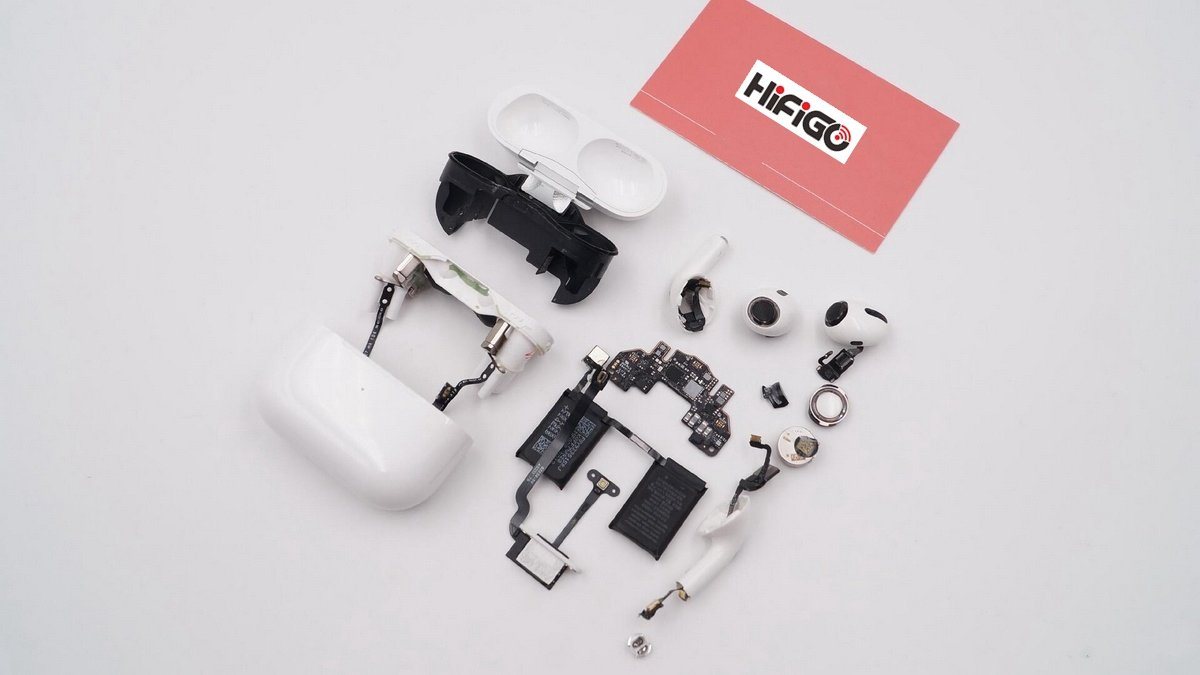
As true wireless earbuds continue to evolve, companies are making them smaller and adding powerful features like active noise cancellation (ANC). We'd heard rumors about a refined design and ANC of AirPods Pro for months. Finally they quietly revealed in a press release on a Monday afternoon. The Pro model introduces a host of new features, but that comes at a cost. And the question is: How is the AirPods Pro ($249) built to worth the extra $50? Let's check.
1.Unpackage of Airpods Pro

The box with familiar smell and characters of Apple.

Product model Airpods Pro with Wireless charging case in 6 languages, certifications and company information.

The package seems a pro version as well, it is thicker than the previous version.

Three stickers on the side.
Earbuds PN: A 2083 A2084
Wireless charging case PN: A2190

Package:
Airpods pro earbuds with charging case.
USB-C to Lightning cable
Manual, warranty card, etc
S, L silicone eartips

Close-up of connectors

The included charging case is different with the previous one. While the previous versions (2.1 x 1.7 x 0.8 inches)look and open more like a floss container, this new one (2.4 x 1.7 x 0.9 inches) is wider and shorter. The new case is noticeably larger, though not by much. It's still quite small, and it's more compact than similar cases from Jabra, Sony and so on. Other than size, that's where the changes to the case itself end.

A button for paring. But you don't need to press it for iPhone paring. It could be used to pair Andriod devices.

Lightning port close-up

Wired charging test with POWER-Z KT001: Voltage: 5.038V and current:0.366A

Wireless charging test with POWER-Z KT001: Voltage: 5.085V and current:0.374A

The metal clips close-up.

Earbuds with case weigh 56.7g, similar to 56.4g Apple claims.

Case weighs 45.6g

10.7g total, similar to 5.4x2= 10.8g Apple claims

Close up of microphone vents

The outward-facing microphone vents.

Press relief vents.
Take a look at the head of the AirPods Pro, which is larger than the previous buds and holds two black mic vents. At the bottom is a slim glossy chrome circle. Toward the end of the bud that goes into your ear is a new and notable addition: a silicon eartip.

The side that faces forward (towards your face) is flat, so you'll know where those controls reside when you reach for them. At the top of the stem sits another vent, hiding another microphone.

The company added a silicon tip that not only makes the AirPods Pro more comfortable but also gives them the seal needed for effective noise cancellation. And the overall shape is now more of an oval instead of a circle.

The stem is shorter than on previous versions of the AirPods and now has a small notch cut into them. Give either a squeeze and you'll discover an embedded Force sensor. The stick-like extension is still here, but it's shorter and houses a new "force sensor" for the on-board controls.
For you fitness fanatics or heavy sweaters, the AirPods Pro are IPX4 rated.
2. Airpods Pro charging case Teardown

The two parts of the charing case are connected with two FPC which connected to the lighting port and NFC charging wire respectively.

FPC connected through socket with glue.

Separate the two parts.

The below part with FPC for button and NFC charging wire.

LED indicator and light port FPC

The other side.

LED indicator close-up

Two batteries with the mainboard in the middle.

The white cover, white earbuds cabin and the black part for fixation.

The charging connectors for the earbuds are connected to the mainboard with fpc and fixed with glue.

Separate the white earbuds cabin first.

The magnet for earbuds fixing during charing.

QR code outside the cabin.

The chip for case detecting opening and closing state of the charging case.

The two batteries and mainboard of the case. Have to remove the glue and get the mainboard first, then take off the batteries.

Close - up of the batteries and mainboard.

Other side of the batteries and mainboard.

Both sides of battery socket are fixed by the black glue which cannot be removed.

The protection circuit of the battery and IC on it are covered by the semi-transparency glue.

Information of the battery.

NXP610A3B KN3704 USB and charging IC.

Close-up of the components side and most components are sealed with semi-transparency glue.
NPO capacitors close-up .

SDG IC

3DG5 IC

3441APAF IC

T5AS KDD IC

C 9AB IC

Two Tj IC

E+ 8N IC

96Q201 IC

120A BBMU IC

TI BQ25116A Charging managing IC

Another IC with 3441 APAF printed

Another IC with T5AS KDD printed

P3W LA IC

K5B C9A 11 IC

STM32L476MGY6 Low-latencyChip from ST and floating-point arithmetic unit.

STM32L476MGY6 datasheet.

59356A2KUBG ,Charing managent IC from BROADCOM

AirPods Pro charging case teardown
3. Teardown of Airpods Pro earbuds

Tech-packed yet compact, AirPods Pro is built around our System in Package design — featuring the H1 chip that powers everything from sound to Siri.

Apple H1 (System in Package) FPC connects the speaker and battery through the socket.

Three parts of the earbuds

The charging connector soldered to the FPC.

Remove the FPC of H1 ( System in Package). There are the battery, driver, microphone and other sensor components.

CP1154 A3HOC battery,made in Germany,3.7V

Remove the battery.

Battery is 0.16Wh.

Speaker unit.

optical sensor close-up.

Powerful bass is delivered by a custom-built high-excursion, low-distortion speaker driver. Remove the speaker driver.

Motion acceleration sensor

The inward-facing Microphone between the speaker diaphragm and the vent. The microphone listens toward the ear, and AirPods Pro cancels the remaining noise detected by this microphone.

The inward-facing Microphone unit and battery unit FPC close-up

Bluetooth antenna connected to the coaxial connector of the H1 system in package.

The metal fixes the earbuds to the charging case and adjusts the center of gravity of the earbuds.

Close up of the metal

The components on the earbuds FPC. Two MEMS microphones and one force sensor.

The other side of the FPC. It is an independent antenna.

Metal fixing structure of force sensor close-up.

Otherside of the force sensor.

234 939 GWM1 MEMS microphone, all the microphones are in same PN inside the earbuds.

The Apple-designed H1 chip close-up. It employs 10 audio cores, creating incredibly low audio processing latency that enables real-time noise cancellation.

The other side of Apple H1 (System in Package)

The amplifier powers the speaker driver to remove background noise and works with the H1 chip to control listening levels. A super-efficient high dynamic range amplifier produces pure, incredibly clear sound while also extending battery life.

AirPods Pro right earbud teardown.

Vertical
- AirPods Pro have two microphones per earbud. The one on the outside detects ambient sound to analyze your surroundings. The second faces towards your ear to pick up any remaining noise that sneaks through. Together, the mics work alongside "advanced software" to continuously monitor your environment and adjust the ANC accordingly. Apple says the setup "adapts" the audio "200 times per second" to keep things sounding their best. Apple says this tech is unique, and it's the first to use the 10 audio cores on the H1 chip to make the adjustment in real time. The company also says that a key difference from other ANC headphones is, even when there's no music playing, the AirPods are still analyzing and adapting based on your environment.
- Apple employs what it calls Adaptive EQ, which automatically tunes the low- and mid-range frequencies to each user's ear. There's also a built-in amplifier that Apple says enhances clarity while also optimizing battery life. It's a lot of techspeak, but the end result is much better audio quality than even the most recent AirPods can muster.
- Apple managed to squeeze three microphones and six sensors into the tiny, redesigned casing and still had room for its lauded H1 chip. They even added eartips.


3 comments
Neeraj Rana
can we change charging soldered to fpc please help
Sameer
Hi I basically lost a part and I don’t know the name, the part is the black rim of the AirPods when you replace the earbuds
Rachid
There are actually 3 mics. Two in the stem that are used for beam-forming and ambient sound ajustment. And one facing inward for the ANC function.
Leave a comment
All comments are moderated before being published.
This site is protected by hCaptcha and the hCaptcha Privacy Policy and Terms of Service apply.